It was winter underground.


The activities of many of the inhabitants of the underworld slowed down—and some slept. Those that could survive being frozen solid slept the deepest, but those that could dig themselves below the frozen ground barely slept at all. The earthworms were among those that chose to dig deep.
Annie (short for Annelida) was an earthworm and to her the whole idea of freezing solid was out of the question.
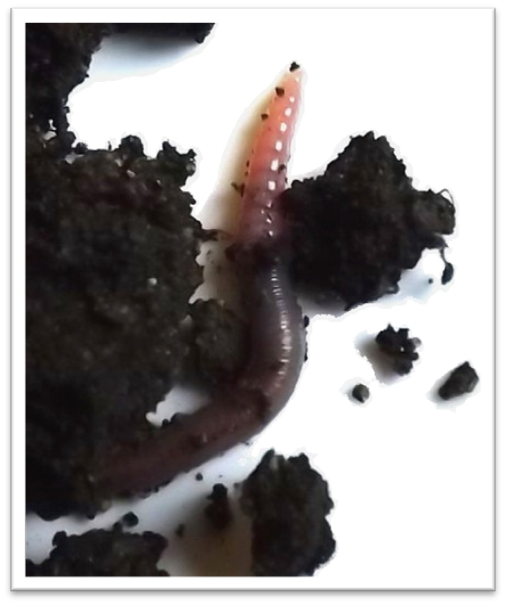
While she and all her earthworm kind do not distinguish themselves as male or female, it was still fun for them to give each other names that seemed to fit their personalities. That is why some of her siblings were “brothers,” others were “sisters,” while still others were cousins, aunts and uncles. It was just a game they all played and they were quite aware just how silly such a game was when they took into account that everyone was “technically” both male and female. All conceptions of relationships, like brothers, sisters and even mothers and fathers, gets a bit convoluted when everyone freely fools around with everyone else. For all she knew, she was actually her mother’s brother’s father.
Deep underground, life goes on—more or less oblivious to the frozen conditions on the surface.
Weeks earlier, they had all instinctively sensed that winter was coming and had burrowed deep into the ground—below the frost line—way down to where it was as wonderfully warm as a worm could want. If the ground got colder—they would just tunnel a little deeper.
They did not sleep much during the winter, but instead they kept tunneling around eating, eating, eating—that was their job after all. Plus of course, there was the “fooling around” part. The dirt, even deep in the ground, was rich with juicy microscopic life forms which adequately sustained them until spring. Excreting, eating, and secreting was pretty much all they did as they burrowed their way through the ground (not all that different from the myriad of life forms above ground). The tunnels they carved through the ground helped bring much needed moisture and air into the ground. Annie and everyone else she knew were all an integral and essential part of nature’s plan. They all knew how true that was, even if there were others that were in denial about it.
As spring arrived the cycle naturally continued and the ground would start to warm. Annie and her family would begin the slow journey toward the surface, where they would find different bugs to forage. Annie looked forward to wiggling through the dense layers of snow-flattened, decaying leaves—that thick mass of now blackened fall-colors loaded with a host of tiny bugs that could please the gizzard of any earthworm.
This particular spring, their trip to the surface was interrupted when they happened upon some sort of immense decaying structure blocking their path. Things blocking their path were not unusual. For example rotting tree roots below the surface were not unusual. In fact it was decaying tree roots that often provided quick routes of access below the surface—sometimes insulating them from a winter that comes too quickly—but this structure was quite different.
Whatever this thing was, it started out like any decaying wood that Annie was familiar with. It was loaded with bacteria, algae, fungi and termites! Any earthworm would consider all of these critters delectable. Of course, feasting on termites was one of Annie’s not-so-secret pleasures—and she made herself sick on them before she moved on—albeit VERY slowly.
Just past this wood structure and its cache of termites, they were immediately inundated with a profusion of matter that was unfamiliar to even the oldest members of the family—but oh so alive with bugs! Even great, great Grandworm had never seen the likes of it. Annie’s combined sense of smell, taste and sight were overwhelmed by this orgasmic organic feast—she quickly forgot the termites.
Much of this mass was laced with an intricate confusion of ethereal rootlets. The rootlets did not impede their movement at all, but they did make for an irresistible subterranean landscape. The mass of roots was clear evidence that all this organic matter was already providing sustenance for some lucky tree or plant on the surface above. It also showed how things above the surface were truly rooted to the ground below.
As they settled in and got to work, Annie wondered if she and her family and friends would even make it to the surface this spring, or whether it might just be better for them to stay right there in this cornucopia of earthly delights.
They tunneled and ate their way through what seemed like an organic deposit of immense size. The sweet castings they left behind would become the rich soil necessary to sustain all manner of present and future life forms—both above and below the ground.
Annie liked this place SO much better than where she only had plain old dirt to eat! She was more than content to remain here for a while.
Annie knew very well what a valuable function she performed and she took her work very seriously—as did all earthworms.
As it turned out, Annie and her family never did make it to the surface that year—or the next year—or the year after that for that matter. They had happened upon sustenance that could last a life time and they could see no good reason to move on. They also found that they didn’t have to dig any deeper to get below frost in the fall. They could just keep working all winter long in that very spot.
Surely this must be heaven, Annie thought.
The entire colony prospered and multiplied until it was many times larger than its original size. When there is an over abundance of food it is only logical that there would also be proportionally more fooling around. Annie had never experienced anything like it—everyone was fooling around with everyone—an underground summer of love!
All through the many months that they worked, ate, and excreted, they began to notice that there were some puzzling inconsistencies in the mass. They kept finding, and had to work their way around, repetitive objects that were totally indigestible. Of course, to Annie and her family, only things that could be eaten mattered to them. Everything else was left to its own devices, becoming a mere curiosity—what else could they do? Like rocks and pebbles for example—they paid no attention to rocks and pebbles and just ate around them when they encountered them.
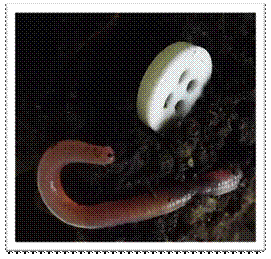
Annie had the most amazing stories to tell about the curious objects that she came across. Her friends and family had their own equally incredible stories. After Annie found a second object that appeared to be identical to the first, she decided to put on her thinking cap and come up with a way to describe the object to her friends and family—in case maybe they had found the same thing too. She thought long and hard, but an adequate description proved very difficult. She knew what rocks were—everyone did. But these were not rocks or pebbles—at least not like any she had ever seen before. She knew what wood was too. This was not wood—she could eat wood. With her combined senses, she could smell, taste, feel and almost “see” wood.
Annie thought about the rings on her body, with their tiny hairs, that she used to pull himself along through the ground or on the surface under the rotting leaves. She thought about how if she looked at just one ring, in her mind’s eye, and then separated it out from between all the other segments of her body, she guessed it might sort-of look like the round objects she had found—especially if she pressed it really, really flat—and got rid of the hairs of course. But never having been inside her own body, she could not say what those flat surfaces actually looked like. The objects that she found had several small holes in them too—and these holes made the objects especially unusual. Of course her body parts were anything but hard and she thought that she could ignore that part—for the sake of the analogy.
She reflected on the analogy she had come up with and thought that perhaps she had at last found a comparison that someone else could possibly understand—as long as she remembered to include the parts about the holes, the lack of hairs and that she didn’t have any hard parts. The holes intrigued her perhaps more than any other aspect about the objects, and were crucial to any description. They were certainly too small for her to crawl through, even if she stretched herself out until she was as thin as possible, but she had cousins and younger siblings that could. Some of the holes had tiny rootlets growing through them—almost as if the roots were trying to hold the objects in place.
She had no idea whether she had such holes in a slice of herself—but how could she know—and she certainly was not interested in finding out.
Hopefully this would still be enough of a description to get her point across, so she stopped thinking about it and inched along through the rich treasure of organic material.
The composition and texture of the stuff made it easy for her to move along almost as if she was on a trail of some sort. It was a lot like the trails of decaying tree roots that she was so familiar with—but some of the bacteria, and fungi tasted different and were so much more bountiful than anything she had ever experienced. As she slowly worked her way along the trail, she encountered several more of the fascinating round flat objects—all seemingly identical—perhaps as many as 6 or 7 if her memory was accurate. They were certainly like no stones she had ever encountered or heard of. It got to the point where she could pretty much predict when she would run into the next one. When she stretched out as long as she could make herself stretch—that is about how far apart they were.
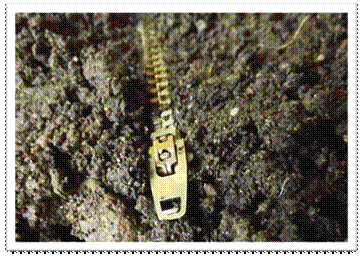
One day however, the trail stopped and so did the objects. She tunneled, off-trail, in all directions with her body fully outstretched, and found no others—but then! In her last most desperate outstretched reach, she found what felt like another trail beginning. This one was a long string of equally perplexing shapes, with a sort of ramp at the beginning. It would surely prove to be an even greater challenge for her to come up with a way to describe this thing.
This string of shapes was long like her—and it had segments too—but not like hers. They were much more like little square castings—actually more “defined,” more like termite frass—all lined up in two rows that slightly overlapped each other—there were also no tiny hairs. All together, they formed a shape more-or-less like her in length. The edges of this unearthly worm were sharper and cold. In that respect they were not at all like either castings or frass. There were no holes either—just the uniform spaces between them. The flat round things with the holes had smooth rounded edges and were not as cold feeling—but they were very hard.


The worm-like object trailed away and curved downward at the end—hanging perilously into some sort of dark abyss. Of course darkness was not unusual underground—but voids were less common. Annie didn’t particularly like voids because her skin would dry out and it would become hard for her to breathe. But the air, underground, was so humid she did not seem to dry out at all.
Annie inched her way along the cold dead worm and she could count its segments with her own segments. She got so distracted with the counting that suddenly she realized that she was hanging head first into the abyss and no matter how much she reached and stretched, left or right, up or down, she could not grasp solid ground. She could not go backward and she dared not go forward. She could feel herself slipping—her segments still reluctantly—unwillingly—counting-off the dead worm’s segments—but Annie was no longer keeping track. Inevitably she had no choice but to give up, and drop off the end of the worm—squirming into the void.
Much to her surprise, and ultimate relief, she landed with a thud on one of her brothers who had been working zealously at the bottom of the abyss—totally unaware that the sky would fall on him. They got themselves untangled and attempted to figure out what had happened—although it is always a good day when you get to squash your brother.
This place turned out to be some sort of hollow space that was partially filled with the richest, most bacteria-packed, organic matter that either of them had ever experienced. She hung out with her brother for a while and she told him about the round objects she had found. She was surprised and delighted when he told her that he knew exactly what she was talking about. She was so proud that her analogy was successful. He had only found one though—but it sure sounded like the same thing to him. The other object—the one she had followed until it had dropped her on top of him—he had no clue about. He also did not see the humor in it.
He had his own amazing stories that she listened to intently. Stories about some long curved round root-like structures that were all lined up like humongous worms tunneling side by side. They were much harder than tree roots and could not be eaten. They were covered with rich nutrients but the nutrients could be cleared away leaving only the hard mysterious smooth surface. Except for their curious shape and length he might have thought they were rocks. But certainly not like any rocks he had ever seen.
Annie could not even begin to imagine what he was describing—no matter how hard she tried. She realized how important “context” was in relation to understanding things. She realized that some things just don’t seem possible to understand—and perhaps don’t even need to be understood. For example the objects she found, that she could accurately describe to her brother, did not bring her any closer to knowing what the heck they were. She knew that some of her friends would feel compelled to make up a reason—to fill the void until perhaps eventually someone did understand—but she thought that was just silly. She felt that the pretension might actually prevent them from ever understanding. But hey—what did she know?
Annie could no longer remember how long they had all remained there, but she was now very old (for an earthworm that is) and she could barely remember being anywhere else. There was a more or less collective sense that they had done all they could do there—and that it was time for most of them to move on. The mass of nutrients they collectively left behind would continue to be put to good use by something, or someone living on the surface above. These lives, whatever or whoever they might be, would then eventually fall to the ground and become food for the many organisms that would in turn be food for Annie’s ancestors—awaiting them on the surface in some far distant springtime.
As they left, they could not help but notice that the entanglement of rootlets that had greeted them all those years ago was now so dense that only the tiniest of earthworms could easily pass through. She took this as further evidence that it was probably time to leave this wonderland all to the nematodes.
But now it was time for Annie and her family and friends to enjoy springtime once again on the surface. There had been whole generations of siblings that had never experienced all the delightful foods the surface had to offer. There were whole generations that had never experienced the change of seasons.
They would take with them the stories of the mysterious objects—the wondrous stories of the find of a lifetime
Their little heaven on earth!